This article is an automatic translation.
freqtables - Christopher Villamarín Projects
Christopher Alexander Villamarín PilaGitHub
This package allows you to create simple frequency tables given a set of variables with their respective frequencies. This data set can be a list, tuple, or a dictionary.
freqtablesimple
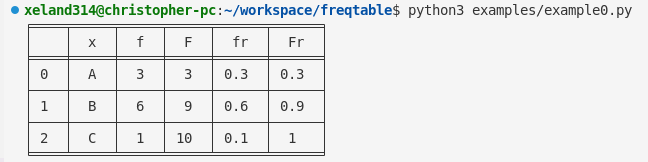
Here are different ways to initialize FreqTableSimpleusing lists, dictionaries, or individual arguments:
import freqtable as fttabla1 = ft.FreqTableSimple(['A', 'A', 'A', 'B', 'B','B', 'B', 'B', 'B', 'C'])tabla2 = ft.FreqTableSimple({'A':3, 'B':6, 'C':1})tabla3 = ft.FreqTableSimple('A', 'A', 'A', 'B', 'B','B', 'B', 'B', 'B', 'C')tabla4 = ft.FreqTableSimple(A = 3, B = 6, C = 1)
Any of these initializations will result in a table similar to this:
freqtable
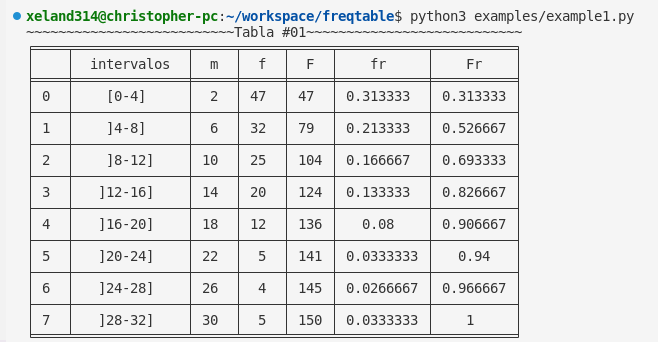
It is also possible to create a frequency table with intervals usingfreqtable.py. For example:
# example1.pyimport freqtable as ft# 8 intervals are created starting from 0 with a width of 4:intervalos = ft.crear_intervalos(8, 0, 4)frecuencias = [47, 32, 25, 20, 12, 5, 4, 5]# The table is initialized with the intervals and frequencies:tabla_con_intervalos = ft.FreqTable(intervalos, frecuencias)
This will result in:
print("Table #01".center(62, "~"))print(tabla_con_intervalos)
Installation
You can clone the repository and then install the necessary dependencies:
git clone https://github.com/xeland314/freqtables
pip3 install -r requirements.txt
requirements.txt
- tabulate >= 0.8.10